

Digital Marketing 2026 Forecast: How AI, Search, and Social Redefine the Landscape
2025 marked a key shift in digital marketing, as AI moved from experimental tools to core infrastructure for automation, content generation, and hyper‑personalized campaigns. AI Search platforms like Google's AI Overviews and engines reshaped discovery, with more users choosing summarized answers over traditional clicks—reaching billions monthly and growing over 500% year‑on‑year (Semrush, 2025).
In 2026, brands must adjust their visibility strategies to adapt to an AI-dominated landscape, prioritizing Generative Engine Optimization (GEO) over isolated keywords. Google now sees AI as the backbone for understanding consumer intent at scale, across broad inspiration and specific product questions.
In this blog, A&W Digital will share our insight on possible practical frameworks action plans for 2026 to help brands adapt and win in the AI‑driven search and social landscape.
SEO in 2026: the Age of AI Search

The AI Search Evolution in 2025
In 2025, AI search became a big part of the default interface for discovery, with Google's AI Overviews and AI Mode placed on top of traditional SERPs.
On the side of traditional search, Semrush highlights that Google AI Overviews already reach 2 billion monthly users and that AI search traffic is growing over 500% year-on-year in some datasets (Semrush, 2025).
Also, in 2025, the rapid updates on AI are now providing us with new search experiences. It is no longer limited to simple search engines, but AI-first browsers such as Comet and Atlas. It turns our everyday browsing into conversational exploration, where users can ask, summarize, compare, and act in natural language, making the experience more human and convenient while pushing browsers closer to always-on personal assistants.
To adapt to this evolution, according to Moz and Google, start treating Google AI Mode and AI Overviews as default search surfaces, prioritizing Generative Engine Optimization by feeding AI-driven journeys with rich, people-first assets that can be understood, retrieved, and cited across conversational flows, rather than isolated keywords and SERPs.
User Behavior Shift
Users nowadays are getting used to AI-generated answers with personalized, summarized responses. This makes traditional average rankings less meaningful. Semrush reports that around 80% of consumers now use AI summaries for at least 40% of their searches, while about 1 in 4 such searches end without further action (Semrush, 2025). This signal users treat AI as the final destination rather than a gateway to multiple websites.
The fact that only 19-20% of users click through cited sources in AI Overviews (Semrush, 2025). Therefore, content that can "end the session" (without requiring further queries) is more valuable than simple clicks, and brand mentions in AI answers improve visibility and memorability more effectively than traffic alone.
SEO Action Plans for 2026

On-Page SEO
Create Content for Natural-language / LLM-style Questions and Conversational Queries
It is recommended to use clear structure, semantic headings, FAQs, definitions, and concise examples that AI models can easily understand and reference. Focus on information gain and cognitive ease by opening with value-led summaries that deliver the "so what" immediately (Moz, 2025), while incorporating clear summaries and FAQ-style segments that AI systems frequently pull for overviews and snippets (Semrush, 2025).
Use Human + AI Collaboration in Content Creation
Make good use of AI, not to fully generate content, but to support a data-driven content strategy, run content audits, and handle tasks like grammar checking and refinement.
Gradually Shift Part of SEM Budget Into Durable SEO Content
In 2026, it is recommended to shift some of your SEM budget into building lasting SEO assets, moving from a narrow "keyword SEO" approach toward creating high-quality content that can surface in Google's AI Overviews and other AI-powered answer engines.
Optimize for E-E-A-T and Clear Entity Definitions
In 2026, focus on making your expertise and entities a clear understanding to both users and AI. Use semantic HTML and structured data so search engines and LLMs can grab entities and concepts on each page. Also, build your own content "ecosystems", topic clusters, internal links, and multi-format assets. Rather than chasing general keywords, create rich, high-quality, diverse content that projects professionalism while giving AI the assets it needs to answer complex, multi-modal queries.
Leverage AI Search Analytics & Visibility Tools
Using AI search analytics and visibility tools to track which queries trigger AI Overviews, monitor if your site gets cited or linked in AI answers, and measure traffic/conversion impact versus traditional SERPs.
Moz recommends tracking AI retrieval and citation frequency across AIO, AI Mode, and LLM tools—instead of just SERPs rankings—while periodically conducting "AI-audits" by asking multiple AI tools what brands they recommend in your category and spotting where yours is missing.
Semrush emphasizes AI visibility as a core KPI: how often your domain appears across AI Overviews, AI Mode, ChatGPT, Perplexity, and other LLM interfaces.
Off-page SEO
Digital PR
Consider prioritizing digital PR that offers unique data, original research, and fresh angles because AIs are far more likely to cite distinctive, evidence-based content than generic rewrites. At the same time, actively optimize for brand sentiment and trust by encouraging reviews, references, and positive third‑party coverage, since these signals influence how models introduce and describe your brand across AI-driven surfaces.
Guest Posting, Backlink Building for High-DA
Aim to become a high-DA, consistently mentioned brand that LLMs trust and naturally prioritize in their answers. Treat your brand mentions as core KPIs for AI visibility, then expand your presence on trusted external platforms (e.g., authoritative blogs, YouTube, and key local communities) that LLMs frequently crawl and reference when assembling responses.
SMM in 2026: Social Platforms Reinvented by AI

Instagram Reels Takeover
Instagram is clearly moving toward a Reels-first experience, launching a version of the app that opens straight into a Reels feed. This shift is backed by behavior data: Reels already account for roughly half of all time spent on Instagram and viewing time is up around 20% year-on-year, signaling that short-form video is becoming the primary format for attention and discovery on the platform.
At the same time, Meta is doubling down on video creation with Edits, a standalone mobile app that gives creators pro-grade camera controls, an advanced editing suite, collaboration features, inspiration tabs, and Instagram-specific performance analytics, all optimized for Reels and short-form video.
AI Video Trends
AI video creation is entering a new phase where smart tools can handle tasks such as cutting, captioning, and repurposing, while audiences double their judgment. Generative video tech can now produce complex, high-quality visuals at scale, and platforms such as Runway, Pika, and Lumen5 make it easier than ever to spin one idea into multiple short-form assets and formats.
SMM Action Plans for 2026
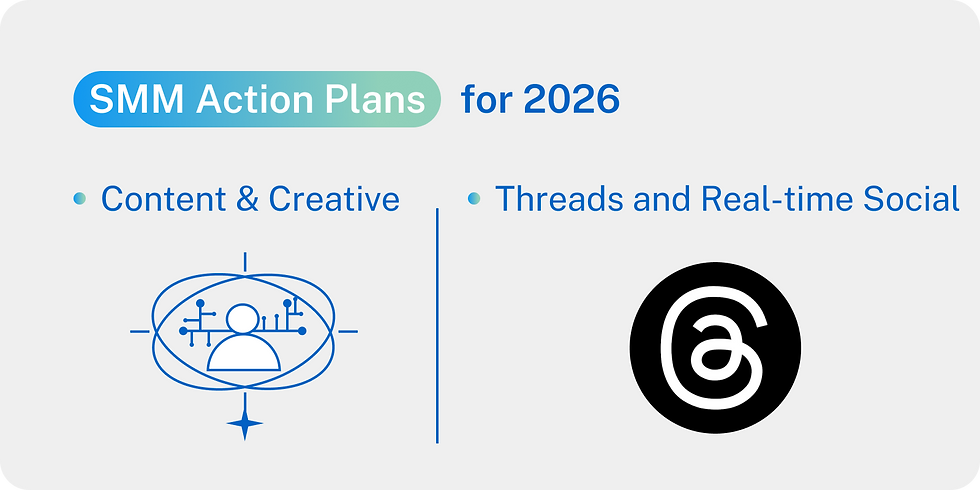
Content & Creative
In 2026, use AI as the production engine by leveraging it to handle edits, formats, and variations. However, keep humans in charge of narrative, tone, and brand safety, because AI can summarize facts but not recreate genuine lived experiences or emotions. Therefore, consider investing in designing taste as a marketing skill. Editing skill is no longer the competitive edge but your creativity.
Threads and Real-time Social
In 2026, avoid putting all your effort into a single platform and instead spread your budget across platforms so one algorithm or policy change cannot wipe out your reach.
For small and new business, leverage Threads, a lower-competition platform, it is more likely to earn organic visibility and conversation.
Conclusion
In 2026, as AI search continues to dominate user discovery through tools like Google's AI Overviews and conversational browsers, success will depend on how well marketers adapt to Generative Engine Optimization, invest in trust‑driven content ecosystems, and measure visibility beyond simple rankings. On social, short‑form video and AI‑enhanced storytelling will define engagement, making originality, emotional resonance, and consistency the new creative edge. The brands that win will be those who actively fuse human insight with AI, creating meaningful, discoverable, and lasting digital footprints.
Get your brand ready for 2026. Work with A&W Digital to boost your search, content, and social strategy. Contact us for a free consultation and let's grow your digital success together.

